
Tuesday, October 30, 2012

AIA lauds use of BIM
Pocketing RA award
From the Academy
Transit City charter
Alumni projects awarded
Students honored
Faculty and staff notes
Staying social
e:View Archive
Contact Us
School of Architecture
View this issue on the web
A group of fourth- and fifth-year students spent the 2011-12 school year designing and building a home in four modules in the school's warehouse in south Fayetteville. The 1,100-square-foot, two bedroom, two bathroom house was done in partnership with the Downtown Little Rock Community Development Corp. The modules were trucked to the historic Pettaway neighborhood in Little Rock in July. Click here to read more. (Photo by Michelle Parks)
AIA lauds use of BIM

This computer rendering shows the southwest corner of the Steven L. Anderson Design Center and Vol Walker Hall. (Image courtesy Marlon Blackwell Architect)
The American Institute of Architects has recognized a building project on the University of Arkansas campus for its use of innovative design technology. Architects for the renovation of Vol Walker Hall and the addition of the Steven L. Anderson Design Center, home to the Fay Jones School, used 'building information modeling' to design the project. Design firms working on the project are Marlon Blackwell Architect, lead architect, and Polk Stanley Wilcox Architects, associate architects.
The project, now under construction, won a 2012 Building Information Modeling Award from the AIA for Exemplary Use of BIM in a Small Firm. This is one of three national AIA awards Blackwell's firm received this year, the most his firm has won in a single year.
Building information modeling is a digital representation of the physical and functional characteristics of a building. The design firms for this university project used Autodesk Revit software for architectural design. The consultants on the project used parallel Autodesk Revit software for their fields ' such as structural engineering and mechanical, electrical and plumbing engineering.
'Each specific group within the team essentially builds the project in the computer three-dimensionally before you go out and build the project physically,' said William Burks, intern architect at Blackwell's firm. Burks is managing the 'integrated project delivery' for the renovation and addition. Integrated project delivery means the architects involved the contractor, Baldwin & Shell Construction Co., with the project from the beginning of design and worked collaboratively through the process.
Designers also obtained the original architectural drawings for Vol Walker Hall and inserted those into the software, then created renovation plans from there. 'It gave us a fully navigable and realistic model that we could interact with and better understand what was going on with the project,' Burks said. 'It allows you to remove any mystery.'
When Burks graduated from the Fay Jones School in 2010, he caught the tail end of primarily two-dimensional production. When designing with two-dimensional drawings, a change made on a plan doesn't automatically transfer to other renderings, like elevations or sections. Three-dimensional computer design allows designers to see 'the exact changes you're making made live. There's nothing that can hide from you at this point,' Burks said.
The software allowed them to better plan the demolition phase of this project ' the removal of the old stacks from the period when the building was the University Library ' and then incorporate new design ideas for the renovation and addition.
Read more about the architects' use of BIM.
Pocketing RA award
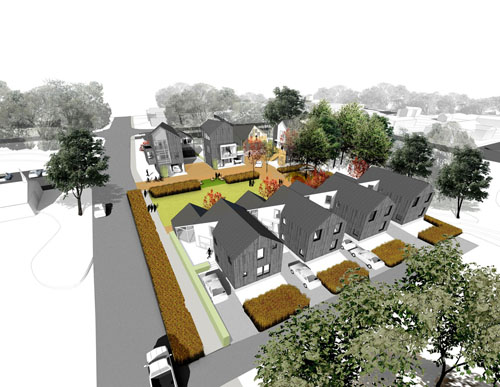
The UA Community Design Center received a Grand Award in the 2012 Residential Architect design awards program for this pocket neighborhood design in Little Rock. (Image courtesy UA Community Design Center)
The Pettaway Pocket Neighborhood project won a Grand Award in the 'On the Boards' category in the 2012 Residential Architect design awards program. The project was a collaboration between fifth-year architecture students in the Fay Jones School and the staff of the University of Arkansas Community Design Center, an outreach program of the school.
With more than 800 projects submitted for these national awards, 36 projects ' including four Grand Award winners ' were chosen among a wide range of housing categories. This is the most comprehensive housing design awards program in the country.
The Downtown Little Rock Community Development Corp. commissioned the Pettaway Pocket Neighborhood project, which architecture students and design center staff tackled in a design studio last fall. The design was partial fulfillment of a planning grant from the National Endowment for the Arts, with funding from the city of Little Rock.
The Community Development Corp. had five adjacent parcels for housing in one of the more open areas of the Pettaway neighborhood, said Stephen Luoni, director of the Community Design Center. Rather than placing one home on each parcel, designers suggested combining the parcels to create a pocket neighborhood. The move nearly doubled the density, placing nine homes around a shared space.
For the pocket neighborhood, designers took resources typically found in each private parcel and pooled them to create a public realm ' including a community lawn and playground, community gardens, a shared street and a low-impact development stormwater management system.
Designers accomplished both urban design and home design in this studio, a difficult feat in one semester. With just nine housing units and a defined, cohesive neighborhood, this project was small enough for students to manage.
'Housing is one of the hardest things that an architect can do, and it's one of the hardest design studios to teach,' Luoni said. 'A designer must draw on every resource at every scale to understand multi-family housing. You really have to understand the social as well as the formal and the technical ' while making architecture and place out of it.'
Read more about the pocket neighborhood design.
From the Academy
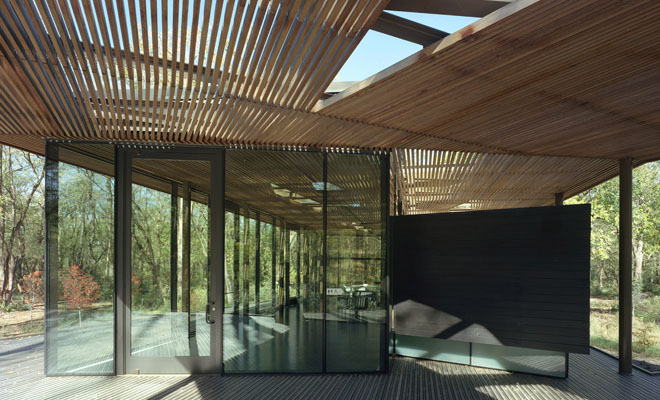
The Ruth Lilly Visitors Pavilion at the Indianapolis Museum of Art's 100 Acres art and nature park. (Photo by Timothy Hursley)
Architecture professor Marlon Blackwell was a recipient of a 2012 Arts and Letters Award in Architecture from the American Academy of Arts and Letters. Members of the academy, established in 1898 to 'foster, assist and sustain an interest in literature, music and the fine arts,' represent the fields of music, art, architecture and literature.
Blackwell is a Distinguished Professor and head of the architecture department in the Fay Jones School, and is a Fellow of the American Institute of Architects. His firm, Marlon Blackwell Architect, is based in Fayetteville.
As Blackwell looked over a list of previous architecture winners ' 59 of them since 1991 ' he shook his head in amazement. 'It's a who's who ' it's a pretty amazing list,' he said. Many on the list have been guest lecturers or visiting professors for the Fay Jones School, among them, Wendell Burnette, William E. Massie, Julie VandenBerg Snow, Tom Kundig, Monica Ponce de Leon and Gregg Pasquarelli. But the names belong to architects from firms in New York, Boston, Chicago, Los Angeles and other major cities. None are from Arkansas, until now.
Upon receiving his nomination letter, Blackwell was required to submit just two documents and a curriculum vitae. These alone had to speak for his work. He wanted to make his entry unique and substantive, but also unified in look and presentation.
So, he took his monograph, An Architecture of the Ozarks, published in 2005 by Princeton Architectural Press, and had it rebound by a local bookbinder. An additional book, in matching gray cloth, includes works done since then. That new book, 'Figures and Types,' shows a range of work, featuring architectural drawings, as well as photographs by Timothy Hursley and Richard Johnson.
'Half the fun was making the book,' Blackwell said. 'It shows the range and dexterity of the work, and how the architecture is situational rather than bound by one overarching theory,' Blackwell said of the collection of projects.
For Blackwell, this recognition is like none before. 'This is the first time that the value of the body of work has been acknowledged as truly significant in the context of the United States,' he said. 'And it's been confirmed as having national significance by some of the most renowned architects of our time.'
In addition, the Gulf States Region of the American Institute of Architects awarded two 2012 Honor Awards to Blackwell's firm for the Ruth Lilly Visitors Pavilion at the Indianapolis Museum of Art's 100 Acres art and nature park and for the museum store at Crystal Bridges Museum of American Art in Bentonville, Ark.
His firm's design for the Cottages at Fallingwater won a 2011 Honor Award for Unbuilt Architecture and Design from the Boston Society of Architects. The design was for cottages to be located on the site of Fallingwater, the famous home designed by American architect Frank Lloyd Wright. His firm was one of six architectural firms chosen to submit a design for the Architectural Design Competition of Ideas.
Read more about the Arts and Letters recognition. Read more about the Gulf States awards. Read more about the Cottages at Fallingwater.
Transit City charter

In Fayetteville 2030: Transit City Scenario, the remote Walton Arts Center is integrated into the new shared street through a covered transit plaza. (Image courtesy UA Community Design Center)
The University of Arkansas Community Design Center's project Fayetteville 2030: Transit City Scenario won an honorable mention in the 2012 Charter Awards. The awards program was sponsored by the Congress for the New Urbanism (CNU), the leading international organization promoting walkable, mixed-use neighborhood development, and sustainable communities.
The Charter Awards recognize excellence in architectural, landscape, and urban designs built in harmony with their physical and social contexts. Awardees are selected for their excellence in fulfilling and advancing the principles of the Charter of the New Urbanism, which defines the essential qualities of walkable, sustainable places from the scale of the region down to the block and building. The 12th annual awards program attracted a competitive field from around the world, and 13 projects were recognized.
The Fayetteville 2030: Transit City Scenario project was sponsored in part by a 2011 planning grant from the National Endowment for the Arts, with matching in-kind resources provided by the City of Fayetteville. This scenario models a future based on development of a streetcar system on College Avenue connecting the downtown/University of Arkansas campus area with the Northwest Arkansas Mall. Recognizing that more than half of Fayetteville's environment projected to exist by 2030 has not yet been built, the plan shows how 80 percent of future growth could be spurred to create a model city for smart growth.
Jury chairman, Douglas Kelbaugh, said this of the Fayetteville 2030 project: 'Speculating boldly in a community that has the economic wherewithal and appetite to realize bold projects, this corridor study promotes transit-oriented development and arterial-strip infill that imaginatively capture the ambitions of the fast-growing community.'
Award winners and honorable mentions, along with full project descriptions, are listed on the CNU Charter Awards web page.
Alumni projects awarded

Timothy Maddox won a Merit Award for his design of Vetro 1925 in the 2012 Fay Jones Alumni Design Awards competition. (Photo by Timothy Hursley)
Thirty-one designs ' for residences and pavilions, culinary, municipal and commercial spaces, and structures dedicated to culture, education and religion ' all vied for recognition in the 2012 Fay Jones Alumni Design Awards competition.
Entries came from Fay Jones School of Architecture alumni practicing in cities around the state, as well as in California, Oregon, Tennessee, Michigan, Illinois, Missouri, Texas, New York, Florida and Washington, D.C. After careful review, the three-member jury chose five projects for accolades ' resulting in three Merit Awards and two Honorable Mentions. Awards were announced and presented April 20 during the school's annual Honors Recognition reception and ceremony at the Arkansas Union on the University of Arkansas campus.
John W. Allegretti (B.Arch. '71) won a Merit Award for Laketown Residence in Saugatuck, Mich. Allegretti is a principal architect at Allegretti Architects in St. Joseph, Mich.
Timothy W. Maddox (B.Arch. '02) won a Merit Award for Vetro 1925 in Fayetteville. Maddox is a principal at deMx architecture in Fayetteville.
Richard Renfro (B.Arch. '79) won a Merit Award for The Morgan Library & Museum ' McKim Building Restoration in New York City. Renfro is a lighting designer at Renfro Design Group in New York.
An Honorable Mention went to Patrick E. Hoy (B.Arch. '78) for Hoy + Stark Architects Studio Office in Tallahassee, Fla. Hoy is owner of Hoy + Stark Architects in Tallahassee.
An Honorable Mention also went to Robert Kerr (B.Arch. '92) for HUeC (Hudson Unenclosed Cabana and Landscape) in Los Angeles. Kerr is a principal at Robert Kerr Architecture Design in Santa Monica, Calif.
Read more about these projects, view a slideshow and see jury comments. View PDFs of all projects.
Students honored

Amanda Neely, Scott McDonald, Nicholas Jabs and Melissa Roberson, then third-year architecture students, attended the reception prior to the Honors Recognition ceremony, held April 20 at the Arkansas Union. (Photo by Beth Hall)
The Fay Jones School honored 85 students at the 2012 Honors Recognition reception and ceremony, held April 20 in the Verizon Ballroom at the Arkansas Union on the University of Arkansas campus. Nearly $110,000 was handed out through scholarships that recognized various aspects of achievement among architecture, landscape architecture and interior design students.
Several students were selected from the entire school for recognition, including:
- Jessica Meehan Crandall, an interior design student who was named the Senior Scholar
- Donna Freeman, a landscape architecture student who received the University of Arkansas Presidential Scholar
- Samuel Annable, an architecture student who received the Alpha Rho Chi Medal
- Dustin Langford, a landscape architecture student who received the Michael J. Buono Sustainability Medal
- Nickolas Cerra, a landscape architecture student who received the Pella Student Essay Award for 'A New Relationship With Nature'
- Brandon Doss (landscape architecture), Chase Humphrey (architecture) and Christina Willis (interior design), who received Professional Advisory Board Fifth-Year Scholarships
Notable recognition for architecture students included:
- Akihiro Moriya, who received the AIA Henry Adams Medal
- Suzana Christmann, who received the AIA Henry Adams Certificate of Achievement
- Erica Blansit, who received the Edward Durell Stone Medal
- Akihiro Moriya and Adam Stevinson, who both received the Barbara C. Crook Medal
- Hanna Ibrahim, who received the C. Murray Smart Medal
Notable recognition for landscape architecture students included:
- William Towle, who received the American Society of Landscape Architects Honor Award, and William Cochran VI, who received the ASLA Merit Award
- William Cochran VI, who received the Verna C. Garvan Medal
Notable recognition for interior design students included:
- Christina Willis, who received the Andrew A. Kinslow Interior Design Scholarship
- Rebecca Buedden, who received the Fairhead-Shipp Family Design Education and Experience Scholarship
Read more about the scholarships and awards.
Faculty and staff notes

Introducing Architectural Theory: Debating a Discipline, edited by Korydon Smith, was published by Routledge.
A recent book edited by Korydon Smith, a former associate professor of architecture, offers a guide to the complexities of architectural theory and thinking critically. While designed as a textbook, Introducing Architectural Theory: Debating a Discipline can be read by anyone interested in the historical development of ideas about architecture.
'We were interested in creating a course that would affect the students' long-term thinking about architecture. We wanted the course, foremost, to provide students with strategies for critical thinking,' Smith said. 'Architectural theory would simply be the medium. We aspired for students to not only understand the origins and trajectories of various architectural theories, but also to verbalize and re-conceptualize their own predilections of architecture.'
Each chapter includes three different views on a topic: an original text, a philosophical text and a reflective text. Introducing Architectural Theory: Debating a Discipline was published in 2012 by Routledge. (This fall, Smith began teaching at the University at Buffalo School of Architecture and Planning in Buffalo, N.Y.)
Mark Boyer, head of the landscape architecture department in the Fay Jones School, was recently elected second vice president of the Council of Educators in Landscape Architecture, the national organization of landscape architecture educators. The council is composed of virtually all the programs of higher learning in landscape architecture in the United States, Canada, Australia and New Zealand. There also are individual and institutional members from many other parts of the world who belong to the organization.
As second vice present, Boyer's duties will include planning and coordinating surveys of members conducted by the regional directors; communicating with the regional directors to encourage and aid in setting up regional meetings; and performing such other activities and tasks as may from time to time be assigned by the board or the executive committee. He is also responsible for the annual faculty and administrator awards program.
Christine Hilker, director of the Smart Multi-Media Resource Center in the Fay Jones School, was recently elected as chairman of the Visual Resources Association Foundation and was appointed to a two-year term on the board of directors. The national association is a 'multi-disciplinary organization dedicated to furthering research and education in the field of image management within the educational, cultural heritage and commercial environments.'
Hilker has been a member of the Visual Resources Association since the mid-1980s and has twice served in elected positions on the association's executive board ' as treasurer from 1990-93 and as communications and public relations officer from 2004-06. She also received the association's Distinguished Service Award in 2008.
Read more about Smith's book. Read more about Boyer's CELA service. Read more about Hilker's VRAF service.
Staying social

This photo of the construction site in September shows the new Anderson Design Center addition, on the left, connecting to Vol Walker Hall. (Photo by Michelle Parks)
Check out our Architecture in the Making blog that follows the progress of the renovation of Vol Walker Hall and the addition of the Steven L. Anderson Design Center.
You can also follow the activities and news of the Fay Jones School through our Facebook page. If you haven't already, please go to our page and 'like' us.

About this email
e:View is an electronic news brief for alumni and friends to keep you informed about the University of Arkansas’ Fay Jones School of Architecture. It is produced by the Fay Jones School of Architecture in partnership with the Arkansas Alumni Association. Please share your comments and suggestions by emailing Michelle Parks at mparks17@uark.edu.
Copyright University of Arkansas’ Fay Jones School of Architecture. All rights reserved.
Fay Jones School of Architecture | 120 Vol Walker Hall | Fayetteville, Arkansas 72701
|