
Surprise gift for Edmondsons
Landscape architecture honorees
Record can collection
City streetcar scenario
Kigali studio exhibit
Call for designs
e:View Archive
Contact Us
School of Architecture
View this issue on the web
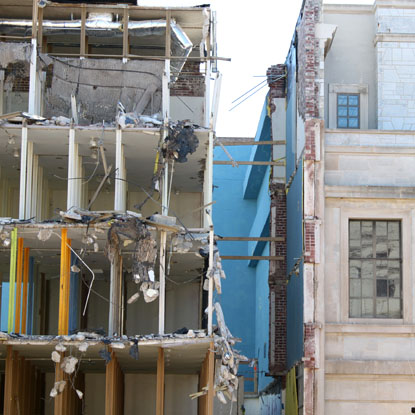
A new blog called " Architecture in the Making" will cover the makeover of Vol Walker Hall during the next two years. Pre-construction started last summer, and the demolition of the old library stacks happened in the fall. Bookmark the blog here, then check in regularly to view the progress of the renovation of Vol Walker Hall and the addition of the Steven L. Anderson Design Center.
Surprise gift for Edmondsons
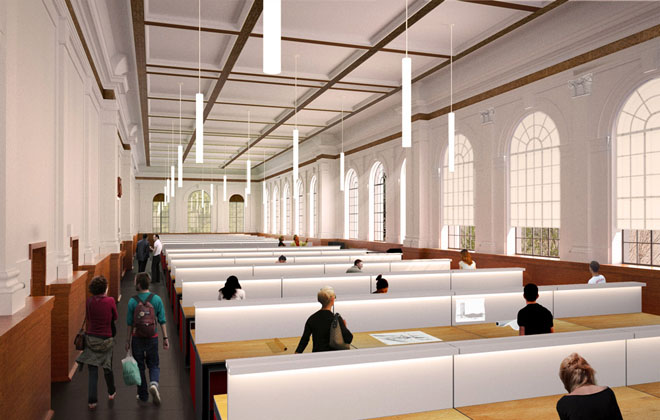
This computer rendering shows the Don and Ellen Edmondson Legacy Studio. (Image courtesy of Marlon Blackwell Architect)
Don and Ellen Edmondson of Forrest City joined close friends for a dinner on Nov. 3 at the Wallace W. and Jama M. Fowler House, the University of Arkansas chancellor's residence. The namesakes of the residence, Wallace and Jama Fowler, were also at the dinner, but they had more than dinner planned for the evening.
The Fowlers, of Jonesboro, announced that they have committed $1 million to name the Don and Ellen Edmondson Legacy Studio in Vol Walker Hall, home to the Fay Jones School of Architecture. The building, built in 1935, is currently undergoing a major renovation and addition.
'Don and I have had a wonderful relationship ' personal and business ' for some 35 years,' said Wallace Fowler, 'and never a cross word. That's something you don't see very often. The Edmondsons are wonderful people, and we think the world of them. The idea for this gift was presented to us, and we thought it was a wonderful way to recognize our friendship and their support of the university. We were fortunate to be able to make this type of commitment.'
In 2008, the Edmondsons made a gift of $10 million to name the Fay Jones School of Architecture to honor the late architect and University of Arkansas professor E. Fay Jones, who was also a dear friend. Over the years, the couple has also funded the E. Fay Jones Architecture Chair and the Maurice Jennings International Experience Endowment to honor Jones' longtime business partner. Don Edmondson chaired the School of Architecture's Campaign Committee and also served on the University of Arkansas Campaign for the Twenty-First Century Committee. He currently serves on the University of Arkansas Board of Advisors.
'Our appreciation for this gift encompasses the love and affection we have for the university and the love and affection we have for Wallace and Jama,' said Don Edmondson (B.S.B.A. 1958). 'It's very seldom that two people get into business together, become friends and it all turns out okay. Other than Senior Walk, my name has never been on anything on the campus, and this is just a lovely way to cap things off between two friends who just happened to be in business together. Ellen and I were both terribly touched. I choke up just thinking about it.'
Read more about this special gift.
Landscape architecture honorees

John Crone, second from right, holds the Arkansas Pioneer Award and is joined by his sons, Ben, Jonathan and Chris, at the awards ceremony in Fayetteville. (Photo by Camilla Crone)
The Arkansas Chapter of the American Society of Landscape Architects honored several landscape architecture alumni and a faculty member from the Fay Jones School of Architecture earlier this fall.
The 2011 Arkansas Chapter of the American Society of Landscape Architects Professional Awards were presented at a banquet at the Fayetteville Town Center. Members of the Oklahoma Chapter of the American Society of Landscape Architects judged the projects.
John Crone, professor of landscape architecture, won the Arkansas Pioneer Award. This award, given periodically by the state chapter, acknowledges a person who has given a body of lifetime work to the profession of landscape architecture in the state. The chapter's Executive Committee nominated Crone for this award. It is only the fourth Pioneer Award given since the early 1990s.
Also at the awards banquet, Brent Vinson and Christopher Suneson won an honor award in the design category for the Arvest Bank in Fayetteville. This category recognizes both built and unbuilt works of landscape architecture. Vinson is a 1993 graduate of the school, and Suneson is a 2001 graduate. Both are members of the school's professional advisory board.
A design team that included Suneson; Conway+Schulte Architects; Oslund and Associates; and the University of Arkansas Community Design Center won an honor award in the planning and urban design category for the MacArthur Park District Master Plan in Little Rock. This category recognizes the wide variety of professional activities that lead to, guide or evaluate landscape architectural design.
In addition, Dave Roberts and Julie Luther of Crafton Tull won a merit award in the planning and urban design category for the Chaffee Crossing Redevelopment Plan in Fort Smith. Luther is a 1997 graduate and member of the school's advisory board. Roberts is a 1989 graduate, former member of the advisory board, and the landscape architect of record for the school's current project to renovate and expand Vol Walker Hall.
Read what the judges said.
Record can collection
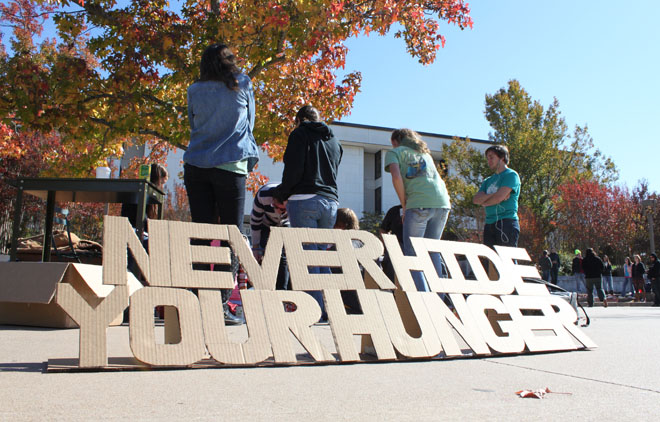
The inspiring 'Never Hide Your Hunger" slogan won a special message award in the fifth annual CANstruction event. (Photo by Michelle Parks)
A cityscape, a gift-laden Christmas tree, and a spider with her web. These designs were winners of the fifth-annual CANstruction event, held Nov. 4 between the Arkansas Union and Mullins Library. But the University of Arkansas Full Circle Campus Food Pantry was also a big winner, as the recipient of the record 4,474 donated canned and packaged food items raised by the event.
First-year design students in the Fay Jones School ' 150 architecture, interior design and landscape architecture students ' constructed sculptures from the collected food.
The prize for most cans used went to the cityscape titled 'Cansas,' which used 1,122 cans ' one-fourth of the event total. The choice for best overall design was also the tallest, the Christmas tree. A pyramid of green-labeled cans, with some red ones interspersed, stood more than 6 feet high. At the base of the tree, presents were represented by pink, red and orange bulk Ramen noodles packages. The best use of labels went to the 'Spider-can' design, which showed a colorful spider and her web, which was created with white cans.
Judges also considered the way the message of fighting hunger came through in the designs, inspiring a special message award for the slogan 'Never Hide Your Hunger.' The sculpture, titled 'Ray-Can,' took the shape of sunglasses.
'What a powerful, powerful, powerful message,' said David Lewis, owner of BHK Kafé and a landscape architecture alumnus, who served as one of this year's judges. 'The face of hunger, because of the economic climate, has changed dramatically over the past few years.'
Two years ago, the class donated more than 4,000 canned and packaged food items to the Northwest Arkansas Food Bank, and they collected more than 3,800 items last year for the Cooperative Emergency Outreach. In the last five years, Fay Jones School students have collected and donated more than 17,600 food items to area community agencies.
The other judges for this year's event were Denise Garner, founder of Feed Fayetteville, a local organization dedicated to alleviating hunger in the community; and Judy Brittenum, associate professor of landscape architecture.
Read more about CANstruction and view a slideshow.
City streetcar scenario
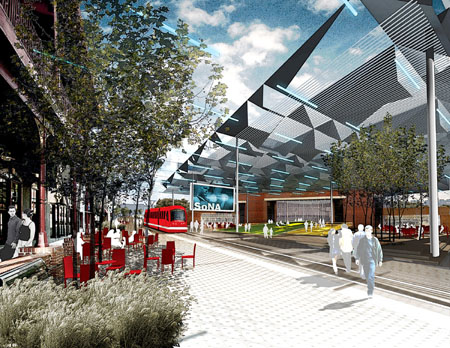
This computer rendering shows how the Walton Arts Center could be integrated into a new shared street thruogh a covered transit plaza. (Image courtesy of the Community Design Center)
The University of Arkansas Community Design Center has completed a 2030 Transit City Scenario Plan that envisions how Fayetteville might create walkable, mixed-use neighborhoods with centrally located housing served by an urban streetcar system.
The center's plan, funded by a grant from the National Endowment for the Arts, considers what Fayetteville could look like if 80 percent of the new growth over the next 20 years were to be located around a streetcar system proposed for College Avenue, the city's main north-south axis and commercial corridor, between downtown and the Northwest Arkansas Mall.
Fayetteville's current population of 73,580 is projected to grow to 125,000 by 2030, entailing an additional 28,000 housing starts. (The city currently has 32,000 housing units.) 'Since close to 50 percent of the built environment projected for Fayetteville has not yet been built, an opportunity exists now to plan an even more intelligent future,' said Stephen Luoni, design center director.
In the past decade, the most prolific and ongoing area of growth occurred west of Interstate 540, with much less happening on the city's east side. Since the economic downturn, that has slowed dramatically. Instead, planners are trying to spark more housing development in the city's interior through urban infill and to discourage suburban sprawl.
The center's scenario would convert College Avenue into a landscaped boulevard with new facilities for pedestrians, cyclists and streetcars, while maintaining automobile traffic. Streetcar environments attract commercial uses, housing of all market grades and types, entertainment, and employment centers, which allow residents to access services without using automobiles, according to Luoni.
If Fayetteville continues its current development trends, new growth will require 300 miles of new roads at a cost of about $600 million by the year 2030, Luoni said. The center's proposed Transit City Scenario replaces that with a streetcar system that would cost about $100 million.
Read more about the streetcar scenario.
Kigali studio exhibit
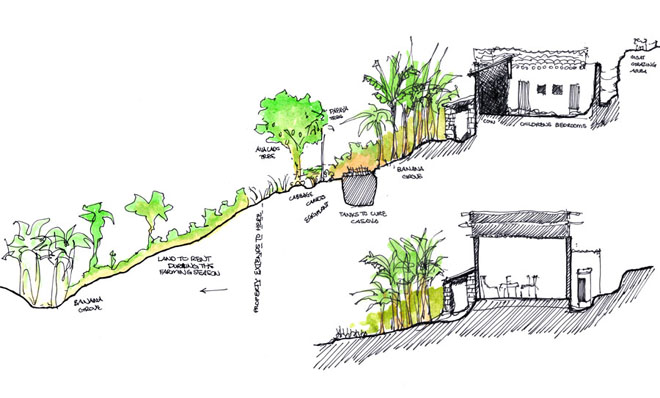
This section drawing by Ginger Traywick was among the work exhibited from the Kigali studio.
Nine architecture students put together a public exhibit of studio work created during and since their journey to central Africa in September. The exhibit, 'Designing Kigali: Revealing the Hidden Intelligence of a Developing African City,' was displayed in November on the main floor at East Square Plaza in Fayetteville. It featured drawings, photographs and models, along with supporting research and design proposals.
For this studio, students worked with Peter Rich, an architect from South Africa who was this year's John G. Williams Visiting Professor in the Fay Jones School, as well as Korydon Smith, associate professor of architecture in the school. Rich was the recipient of the 2009 World Building of the Year award at the World Architecture Festival. His design practice focuses on creating authentic contemporary African architecture.
Students in the studio were Samuel Annable, Andrew Arkell, Ryan Campbell, Enrique Colcha, Long Dinh, Kareem Jack, Hanna Ibrahim, Tanner Sutton and Ginger Traywick. Arkell and Ibrahim are both Honors College students. Students and faculty also worked with Tomá Berlanda and Sierra Bainbridge, faculty members in the architecture program at the Kigali Institute of Science and Technology.
During two weeks in September, the Fay Jones School students and faculty traveled to Kigali, Rwanda, which is a fast-growing city comprising historic neighborhoods, modern developments and informal 'squatter' settlements. There, each Arkansas student was paired with one student from the Kigali Institute to conduct interviews and develop architectural sketches in both rural and urban households.
They sought to understand the relationship between daily life and domestic space, such as material and spatial manifestations of cooking, eating, bathing, etc. They recorded verbal responses in field notes, and developed on-site sketches of land use, building-site relationships, territoriality, interior and exterior space and construction systems. Their research and analysis led to the nine individual design proposals for a central neighborhood in Kigali.
Read more about the studio and exhibit.
Call for designs
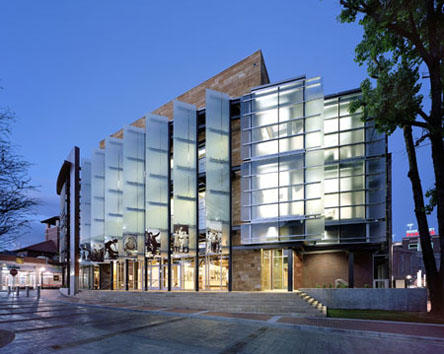
The Arkansas Studies Institute in Little Rock, designed by Reese Rowland (B.Arch. '90) of Polk Stanley Wilcox Architects, won the Honor Award in the 2011 Fay Jones Alumni Design Awards competition. (Photo by Timothy Hursley)
The deadline is fast approaching for the 2012 Fay Jones Alumni Design Awards, awarded by the Fay Jones School of Architecture. We need your entries so we can recognize your design work!
Any architecture, landscape architecture or interior design graduate of the University of Arkansas may submit projects.
Winning projects will be featured in Re:View magazine, and all submissions will be featured on the Fay Jones School of Architecture website.
For revised submission guidelines, visit fayjones.uark.edu/488.php.
Deadline: Submissions must be postmarked no later than Feb. 10, 2012.
About this email
e:View is an electronic news brief for alumni and friends to keep you informed about the University of Arkansas’ Fay Jones School of Architecture. It is produced by the Fay Jones School of Architecture in partnership with the Arkansas Alumni Association. Please share your comments and suggestions by emailing Michelle Parks at mparks17@uark.edu.
Copyright University of Arkansas’ Fay Jones School of Architecture. All rights reserved.
Fay Jones School of Architecture | 120 Vol Walker Hall | Fayetteville, Arkansas 72701
|